

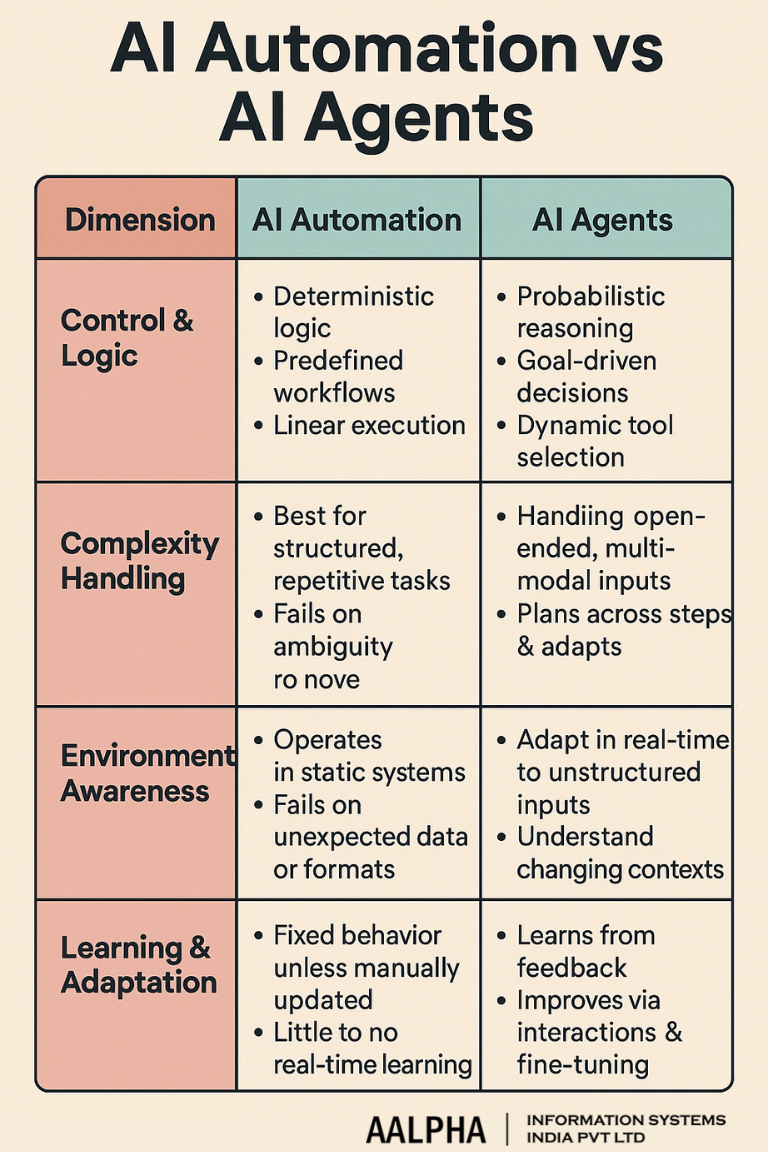
 Image Source: Web. Copyright claims: claims@theusefulindex.com — We will remove it in 24 hours.
AI Automation vs AI Agents: The Definitive Guide to Choosing the Right Tool for Business
In the current enterprise technology landscape, the distinction between AI automation and AI agents is frequently blurred by marketing terminology. However, for a CTO or operations leader making budget decisions, understanding this difference is critical. One approach executes predictable tasks based on rigid rules; the other adapts to context and makes independent decisions.
This guide clarifies AI automation vs AI agents, defines their operational boundaries, and provides a decision framework for implementing business process automation strategies that drive ROI without introducing unacceptable risk.
Defining the Core Concepts
To make an informed choice, you must first understand what each technology fundamentally does.
AI Automation (Deterministic Workflows)
AI automation refers to software that performs repetitive tasks based on pre-defined rules and logic. These systems follow a linear path: if input A occurs, execute step B. They excel at high-volume processing where consistency is paramount. This is often referred to as Robotic Process Automation (RPA) augmented with basic AI for data extraction or classification.
AI Agents (Autonomous Decision Making)
AI agents are software entities capable of perceiving their environment, reasoning over that context, and taking actions to achieve a goal without human intervention at every step. Unlike automation, which waits for a trigger, an AI agent can plan multi-step workflows, search for information, and adapt if a tool fails or data changes mid-task.
Key Differences at a Glance
The following table outlines the technical and operational distinctions between standard workflow automation and autonomous agents.
| Feature | AI Automation (Workflow) | AI Agents |
|---|---|---|
| Logic | Deterministic (If/Then rules) | Probabilistic & Adaptive (LLM-based reasoning) |
| Autonomy | Low (Requires human trigger) | High (Self-starting upon goal assignment) |
| Error Handling | Stops or alerts on failure | Attempts recovery strategies automatically |
| Cost Structure | Low per operation; scalable | Higher compute cost; token usage based |
| Best For | Data entry, invoice sorting, scheduling | Customer support resolution, research analysis |
| Risk Profile | Low (Predictable behavior) | Medium-High (Hallucination potential) |
When to Use Conventional Workflow Automation
Conventional automation remains the backbone of operational efficiency. You should prioritize this approach when your requirements involve predictable inputs and desired outputs.
- Data Migration & Cleaning: Moving data from legacy systems to a CRM where field mapping is static.
- Invoice Processing: Extracting vendor details and matching them against purchase orders using strict validation rules.
- Employee Onboarding: Sending welcome emails, creating accounts, and provisioning hardware based on an HR form submission.
In these scenarios, the input data does not change unexpectedly, and the business logic is stable. Using an AI agent for these tasks would be inefficient and unnecessarily expensive due to higher compute costs and increased latency.
When to Deploy AI Agents for Business
AI agents for business become necessary when the environment is volatile or requires judgment calls that rule-based systems cannot make.
- Customer Support Escalation: An agent can read a ticket, search internal knowledge bases, check inventory status, and draft a response based on tone and policy, rather than just selecting from a dropdown menu.
- Market Research Analysis: Scanning news feeds and earnings reports to summarize sentiment shifts for a quarterly strategy meeting.
- Complex Procurement: Negotiating with suppliers by checking pricing history across multiple vendors and suggesting optimal contracts.
Agents are appropriate when the workflow requires “reasoning” or handling exceptions that deviate from the standard path. If a process requires human intervention only 1% of the time, automation may suffice. If it requires intervention 40% of the time due to ambiguity, an agent is the better fit.
Costs and Implementation Risks
Adopting these technologies carries distinct financial and operational implications.
Cost Considerations
- Automation: Licensing fees are generally lower. The primary cost is development time for rule configuration. Maintenance costs drop as volume increases.
- Agents: Operating costs scale with compute usage (token consumption). Development requires prompt engineering, context management, and integration of multiple APIs. Expect higher initial infrastructure investment.
Risk Factors
- Automation Risk: Primarily relates to logic errors. If the rule is wrong, every execution fails identically. This is easy to audit.
- Agent Risk: Agents can “hallucinate” facts or access unauthorized data if permissions are misconfigured. The non-deterministic nature means two identical requests might yield different results.
Human Oversight and Security Considerations
Security and governance are paramount when moving from rigid automation to autonomous agents.
The Human-in-the-Loop (HITL)
For business process automation, a human review is often built into the final step before action is taken. For AI agents, HITL should be reserved for high-stakes decisions (e.g., financial approvals). You must define clear boundaries where an agent stops and waits for human confirmation.
Security Architecture
- Data Privacy: Ensure agents do not access sensitive PII unless explicitly authorized via zero-trust principles.
- Prompt Injection: Agents are vulnerable to prompt injection attacks where users try to override system instructions. Sandboxed environments are required for production use.
- Audit Trails: Unlike automation logs which are binary (success/fail), agent logs must record the reasoning chain (Chain of Thought) to allow post-incident analysis.
Decision Framework: Choosing Your Path
When evaluating whether to upgrade from traditional tools to AI agents, follow this framework:
- Map the Process: Identify every step in the workflow.
- Identify Variables: Note where input data changes unpredictably (e.g., customer complaints vs. form submissions).
- Assess Exception Rate: If exceptions occur less than 5% of the time, stick with automation. If higher, consider agents.
- Evaluate Cost of Error: If an error costs $0.10 (data entry), automation is fine. If an error costs $10,000 (legal compliance), require human oversight or use a hybrid agent model.
- Pilot Phase: Start with a small subset of data to test agent reliability before full rollout.
Conclusion
The choice between AI automation and AI agents is not about which technology is superior, but which fits the operational context. Traditional automation provides stability for predictable tasks, while AI agents offer adaptability for complex, unstructured problems. By understanding these distinctions and applying the decision framework above, organizations can optimize their business process automation strategy to balance efficiency with control.
Key Takeaways
- Automation follows fixed rules; AI Agents make decisions based on context.
- Use automation for high-volume, predictable tasks like data entry or scheduling.
- Use agents for tasks requiring reasoning, research, or handling unexpected variables.
- Monitor agent costs closely, as compute expenses scale with usage intensity.
- Maintain