

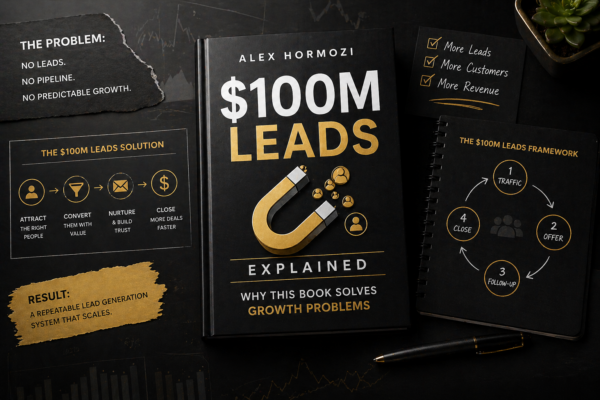
 Image Source: Web. Copyright claims: claims@theusefulindex.com — We will remove it in 24 hours.
In competitive markets, entrepreneurs often find themselves trapped in a race to the bottom, competing solely on price. Alex Hormozi’s $100M Offers provides a definitive roadmap out of this cycle. The book argues that sustainable growth does not come from marketing hacks alone, but from constructing offers so valuable that customers feel stupid saying no.
This editorial breaks down the core framework of the 100M Offers summary, focusing on the mechanics of value creation. We examine how to apply the Alex Hormozi value equation to digital products and service businesses, ensuring you can charge premium prices while increasing demand.
The Problem: Why Price Competition Fails
Most small business owners operate under the assumption that marketing is the primary driver of revenue. While traffic matters, it is insufficient if the offer lacks structural advantage. When two competitors provide identical services, the only lever left is price. This creates a commoditized market where margins shrink and customer loyalty evaporates.
The core thesis of $100M Offers is that you must change the equation before changing the marketing. By increasing perceived value, you shift the dynamic from “who can charge less” to “who provides more value.” This allows for premium pricing strategies that cover overhead and generate profit without sacrificing volume.
The Grand Slam Offer Framework
The central concept in this 100M Offers summary is the Grand Slam Offer. An offer is a “grand slam” when it solves a specific problem so effectively that the customer perceives high value immediately, regardless of the cost.
To construct an irresistible offer, you must manipulate four specific variables. This is known as the Alex Hormozi Value Equation.
Deconstructing the Value Equation
Hormozi defines value not as what you give away, but as the benefit received relative to the cost. The equation is:
$$ \text{Value} = \frac{\text{Dream Outcome} \times \text{Perceived Likelihood}}{\text{Time Delay} \times \text{Effort and Sacrifice}} $$
To maximize value, you must maximize the numerator (benefits) and minimize the denominator (friction).
| Variable | Definition | Strategic Levers to Increase Value |
|---|---|---|
| Dream Outcome | The ultimate result the customer desires. | Focus on the transformation, not just features. Use aspirational language that aligns with their deepest goals. |
| Perceived Likelihood | The confidence the customer has in achieving the outcome. | Add social proof, case studies, and credentials. Offer a guarantee to remove risk. |
| Time Delay | How long it takes to achieve the result. | Accelerate delivery timelines. Use “fast-track” options or immediate access to results. |
| Effort/Sacrifice | The time, money, and energy required from the customer. | Provide turnkey solutions, templates, and onboarding support to reduce manual work. |
How to Make a Grand Slam Offer
Creating an offer that feels like a “grand slam” requires specific structural elements beyond just the core product. This section details how to implement these elements based on 100M Offers key takeaways.
1. Bonuses as Value Multipliers
Bonances are often misunderstood as discounts. In the Hormozi framework, bonuses are value-adds that increase the perceived worth of the main offer without increasing cost proportionally.
- The Rule: Every bonus must be relevant to the core outcome.
- Strategy: If your main product is a course on fitness, a bonus should be meal plans or workout gear, not a generic notebook.
- Math: If a customer values the main offer at $1,000, add bonuses they value at $500. The total perceived value becomes $1,500, but your actual cost increases by only 20%.
2. Risk Reversal and Guarantees
A guarantee reduces the Time Delay and Effort/Sacrifice variables in the customer’s mind regarding risk. It signals confidence in the outcome.
- Implementation: Offer a “no-questions-asked” refund or a performance-based bonus.
- Impact: This increases the Perceived Likelihood that the customer will not lose money, effectively lowering the barrier to entry.
3. Pricing Strategies Beyond Cost-Plus
Most businesses use cost-plus pricing (Cost + Margin). Hormozi advocates for value-based pricing.
- Cost-Plus: You sell a $10 product at $20. If you compete on price, you sell at $18.
- Value-Based: You identify the customer’s dream outcome is worth $100 to them. You structure the offer to capture that value.
- Strategy: Anchor the price higher than competitors. This forces customers to justify their purchase based on your unique value proposition rather than a price comparison.
Real-World Application of the Framework
To understand how to make a grand slam offer in practice, consider two scenarios where this framework transforms standard services into premium products.
Scenario A: The Fitness Coach
- Standard Offer: Monthly coaching calls for $100/month.
- Grand Slam Pivot: A 90-day transformation program.
- Dream Outcome: Lose 20lbs and gain energy.
- Likelihood: Video check-ins, community group, nutrition audit included.
- Time Delay: Weekly meal plans provided immediately upon signup.
- Effort: Automated workouts sent via app; no manual scheduling required.
- Result: Price increases from $100/month to $1,500 lump sum or $2,000/year because the effort and risk are reduced significantly.
Scenario B: The Digital Agency
- Standard Offer: Website design for $3,000.
- Grand Slam Pivot: “Revenue-Generating Site Package.”
- Dream Outcome: Increase leads by 50%.
- Likelihood: Case studies from similar industries; money-back guarantee if traffic doesn’t increase.
- Time Delay: Launch in 7 days instead of 3 weeks via pre-built templates.
- Effort: Client provides content only; agency handles design and deployment.
- Result: Price increases to $10,000 because the outcome is tied directly