

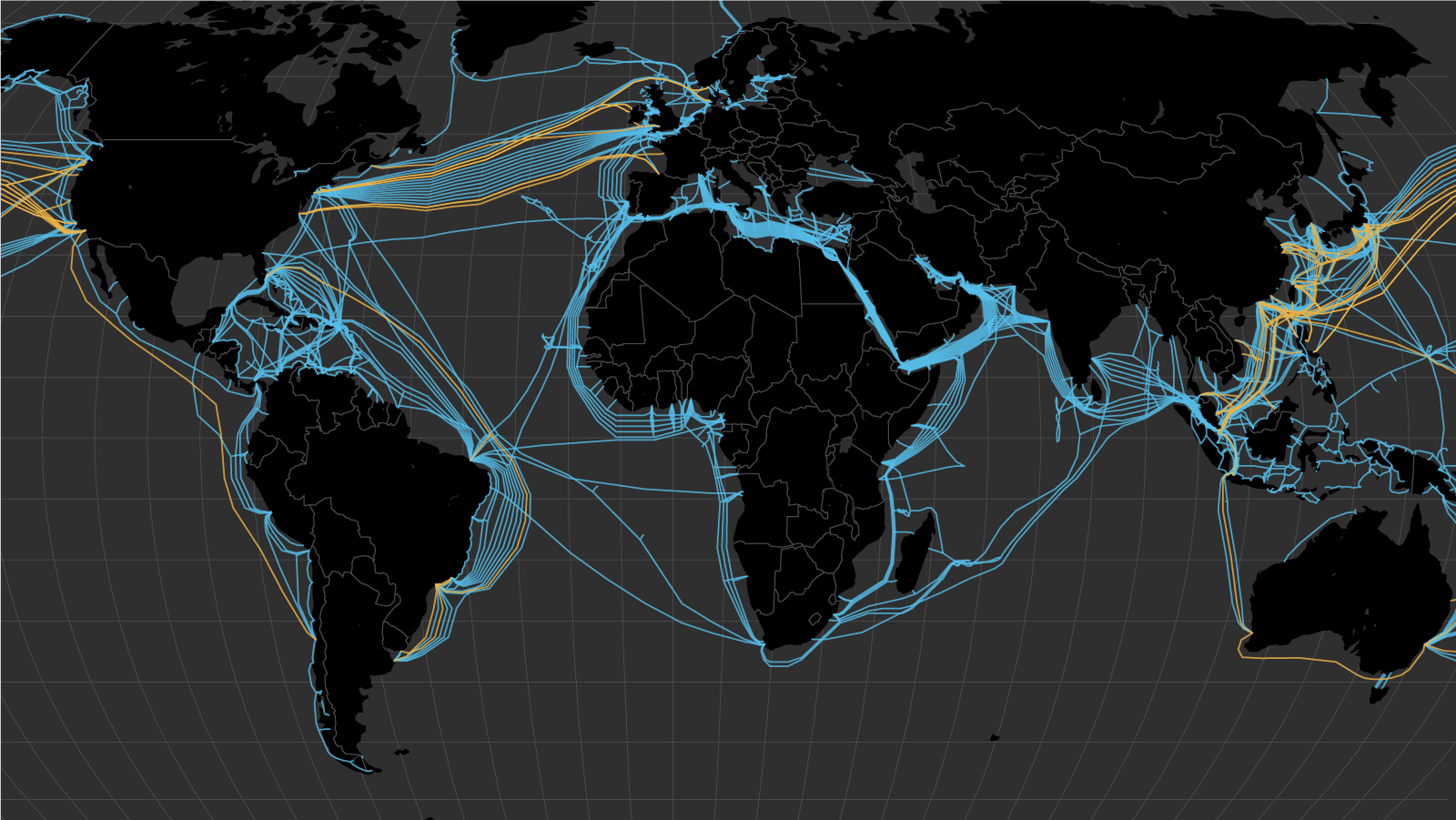
 Image Source: Web. Copyright claims: claims@theusefulindex.com — We will remove it in 24 hours.
The Physical Reality of Global Connectivity
When you stream a video or send an email to someone on the other side of the ocean, the action feels instantaneous. However, the internet does not float in the air around us. It runs on a massive network of physical infrastructure spread across the globe. Understanding how international internet works requires looking beneath the digital surface at the hardware that enables how data travels around the world.
While satellites handle specific tasks like remote sensing and last-mile connectivity, the backbone of global communication relies almost entirely on terrestrial and submarine assets. This article breaks down the engineering behind undersea internet cables, landing stations, and routing protocols that keep the network stable.
The Backbone: Submarine Fibre-Optic Cables
The vast majority of cross-border data traffic is not beamed from space but transmitted through the ocean floor. Undersea fibre-optic cables are responsible for moving data between countries and continents at high speeds.
Capacity and Reach
A single submarine cable system can carry enough data to support millions of households. These cables utilize glass strands (fibre) that transmit light pulses, encoding binary data into signals that travel across thousands of miles without significant degradation.
- Coverage: The network spans almost every ocean on Earth, connecting North America to Europe, Asia to Australia, and Africa to South America.
- Dominance: According to recent infrastructure analysis, these cables carry roughly 99 percent of international data traffic. Satellites are used for redundancy or specific remote areas but do not handle the bulk of commercial web traffic.
The Cable Architecture
Undersea cables are not simple wires; they are complex engineering feats designed to withstand extreme pressure, temperature changes, and physical damage from anchors or fishing gear. They typically consist of:
- Armouring: Steel wire layers protect the cable from external threats.
- Sheathing: A waterproof jacket protects the inner fibres.
- Optical Fibres: The core strands that carry the light signals.
From Ocean to Land: Landing Stations and National Backbones
Once a submarine cable reaches the shore, it must connect to the local network. This connection happens at a specific facility known as a landing station.
Function of Landing Stations
A landing station serves as the gateway between the international undersea network and the domestic internet. Here is what occurs inside these facilities:
- De-multiplexing: The cable carries multiple signals; equipment separates the data destined for the local country from traffic passing through to other nations.
- Interconnection: Local ISPs (Internet Service Providers) connect their routers to the landing station’s optical network units (ONUs).
- National Backbone: From the landing station, data travels over land-based fibre rings to reach residential and business users.
Without these landing stations, the global web would remain disconnected from local networks.
Routing: How Data Finds Its Way
Data does not travel in a straight line; it follows a path determined by routing protocols. This process determines how international internet works on a logical level.
Internet Exchange Points (IXPs)
When data enters a country, it often needs to reach a specific server or another ISP. To avoid unnecessary latency, traffic is routed through Internet Exchange Points (IXPs). An IXP is a physical location where different networks connect and exchange traffic directly.
- Direct Peering: Instead of routing traffic through a third party, networks meet at an IXP to exchange data locally.
- Efficiency: This reduces the number of hops data must take, improving speed and security.
Border Gateway Protocol (BGP)
The internet uses BGP to decide which path is best for data packets. Routers at landing stations and IXPs constantly communicate to map the global network topology. If a specific route becomes congested or unavailable, BGP automatically reroutes traffic through an alternative path. This dynamic routing ensures that even if one cable fails, the connection remains active via other routes.
Redundancy and Latency: What Happens When Things Break
The internet is designed with redundancy to handle failures. However, when a physical break occurs, it impacts how data travels around the world.
Cable Damage Scenarios
Submarine cables are frequently damaged by anchors, fishing nets, or natural disasters like earthquakes.
- Impact: A single cable cut can reduce capacity significantly if that cable is a major transit route.
- Latency Spikes: When traffic is rerouted around a broken cable, it may take a longer physical path. This increases latency—the delay before a transfer of data begins—causing slower browsing speeds and potential timeouts for real-time applications like VoIP or gaming.
Redundancy Strategies
To mitigate this, major internet providers utilize multiple cables between continents. If one system fails, traffic automatically shifts to parallel systems. However, if all cables in a specific corridor are cut simultaneously (a “single point of failure” scenario), connectivity is severely degraded until repairs are made. Repairing a submarine cable can take weeks due to the logistical challenge of locating the break and deploying a repair vessel.
Comparison: Undersea Cables vs. Satellites
While satellites play a role in global reach, they differ fundamentally from undersea internet cables regarding capacity and usage.
| Feature | Submarine Fibre Cables | Satellite Internet (LEO/MEO) |
|---|---|---|
| Primary Use | 99% of international data traffic | Remote sensing, backup, remote areas |
| Latency | Low (speed of light in glass) | Higher (depends on orbit distance) |
| Capacity | Extremely High (Terabits/second) | Limited by bandwidth spectrum |
| Durability | Protected by ocean floor | Susceptible to weather/orbital debris |
| Cost | High initial capex, low opex | Lower deployment cost, high data cost |
Key Takeaways: The Decision Framework for Connectivity
For technical stakeholders and general readers seeking clarity on global infrastructure, the following points summarize how international internet works:
- Physical Infrastructure: The internet is a physical network of cables, routers, and servers. It does not exist solely in the cloud.
- Dominance of Cables: Submarine fibre-optic cables carry nearly all cross-border traffic, making them more robust than satellite links for high-volume data.
- **Redundancy