

 Image Source: Web. Copyright claims: claims@theusefulindex.com — We will remove it in 24 hours.
How Much Electricity Does an AI Data Center Actually Consume?
The rapid expansion of artificial intelligence has intensified scrutiny regarding AI data center electricity consumption. While headlines often cite sensationalized figures, the reality requires a granular look at hardware efficiency, cooling infrastructure, and workload distribution. As we navigate 2026, understanding the true scale of AI energy usage is critical for policymakers, investors, and sustainability officers.
This editorial breaks down the specific metrics defining how much power an AI data center uses, separating facility capacity from actual consumption to provide a clear picture of the sector’s energy footprint.
The Scale of 2026 Energy Demand
To understand how much power does an AI data center use, we must distinguish between total data center demand and the specific load driven by generative AI models. According to Gartner projections for 2026, global data centers are expected to consume approximately 565 Terawatt hours (TWh) of electricity.
Within this total, AI-driven workloads account for a significant portion. Axis Intelligence estimates that AI drives 47.3% of the energy demand within these facilities by late 2026. This represents a sharp increase from previous years where general data processing dominated the load profile.
It is important to contextualize these figures against global baselines. In 2024, total electricity consumption from data centers was estimated at around 415 TWh, representing about 1.5% of global electricity consumption. By 2026, this sector is projected to grow at a compound annual rate of roughly 12%, with AI acting as the primary accelerator for this growth.
Global Data Center Consumption vs. AI Contribution (2026 Estimates)
| Metric | Value (2026 Projection) | Source Context |
|---|---|---|
| Total Data Center Electricity | ~565 TWh | Gartner / Axis Intelligence |
| AI-Specific Share | ~47.3% of Total | AI workload intensity |
| Global Electricity Share | ~1.5% (2024) -> 3% (2030 Proj) | IEA / Our World in Data |
| Year-over-Year Growth | ~12% | Historical trend (last 5 years) |
Hardware Intensity: GPUs and Servers
The primary driver of increased AI data center electricity consumption is the shift from traditional CPU-centric workloads to GPU-accelerated clusters. General-purpose servers typically consume between 300W and 600W under load, whereas AI training nodes utilizing NVIDIA H100 or equivalent architectures can draw significantly more during peak inference or training cycles.
Server Power Profiles
- Standard Web Servers: Low power density (approx. 5 kW per rack).
- AI Training Clusters: High power density (up to 40-50 kW per rack).
- GPU Inference Nodes: Moderate-to-high draw, dependent on model size and batch throughput.
The distinction lies in utilization. A facility designed for AI training often has a higher baseline capacity requirement than one hosting standard cloud services. However, facility capacity versus actual consumption is frequently misaligned. Data centers often operate at 50-70% of peak capacity during the day but maintain high cooling loads to prevent thermal throttling during peak demand spikes.
The Cooling Factor and PUE
Electricity usage in data centers extends beyond compute hardware. A significant portion of AI energy usage is allocated to cooling systems, which remove heat generated by high-density GPU clusters.
Power Usage Effectiveness (PUE)
Power Usage Effectiveness (PUE) measures the ratio of total facility energy to IT equipment energy.
- Ideal PUE: 1.0 (All power goes to servers).
- Industry Average: 1.5 to 1.6.
- Modern AI Facilities: Targeting 1.2 to 1.3 using liquid cooling and free-air techniques.
If a facility operates at a PUE of 1.5, for every 1 Watt used by the GPU, 0.5 Watts are consumed by cooling infrastructure (fans, pumps, HVAC). As AI models scale, heat density increases, forcing more energy into cooling loops. This is where water considerations become critical, particularly in regions with water scarcity.
Water Consumption and Cooling
Liquid cooling is becoming mandatory for high-performance AI clusters to manage the thermal output of modern GPUs.
- Evaporative Cooling: Consumes significant potable water but offers high efficiency in dry climates.
- Direct-to-Chip Liquid Cooling: Reduces reliance on air conditioning but requires closed-loop water management systems to prevent evaporation loss.
Data centers are increasingly located near renewable energy sources and cooling reservoirs to mitigate the environmental impact of AI data center electricity consumption. The IEA notes that without efficiency improvements, the combination of compute and cooling could push the sector toward a higher percentage of global grid load by 2030.
Workload Differences: Training vs. Inference
Not all AI tasks consume the same amount of energy. This distinction is vital when analyzing AI energy usage statistics.
- Model Training: Requires massive, sustained compute power for weeks or months. This phase accounts for the majority of carbon and electricity costs in the lifecycle of a large language model (LLM).
- Model Inference: Occurs after training is complete. It involves serving requests to users. While less energy-intensive per request than training, inference scales linearly with user demand, leading to variable power spikes.
In 2026, optimization efforts focus heavily on reducing inference latency without increasing power draw. Techniques like sparse computing and mixed-precision arithmetic allow models to run faster on the same hardware, effectively lowering how much power does an AI data center use per query.
Facility Capacity vs. Actual Consumption
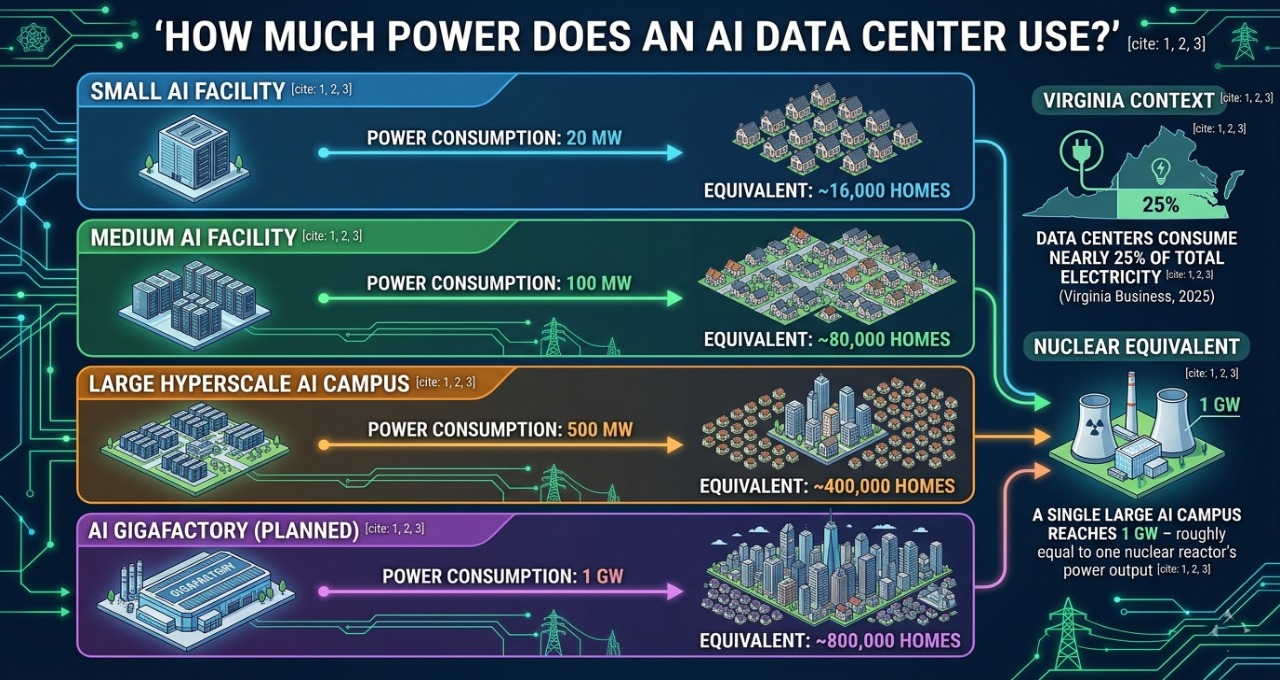
A common misconception is that a 10MW facility consumes 10MW continuously. In reality, facility capacity versus actual consumption is dictated by workload scheduling and efficiency protocols.
- Idle Load: Servers in standby mode still draw power for fans and memory retention.
- Peak Shaving: Grid operators require data centers to throttle back during grid stress events.
- Geographic Siting: Facilities are often placed in colder climates or coastal areas to leverage natural air cooling, reducing the PUE penalty.
Recent analysis suggests that while AI is driving demand up, many existing facilities are being repurposed rather than built from scratch. This transition helps stabilize the growth rate of AI data center electricity consumption relative to new construction costs.