

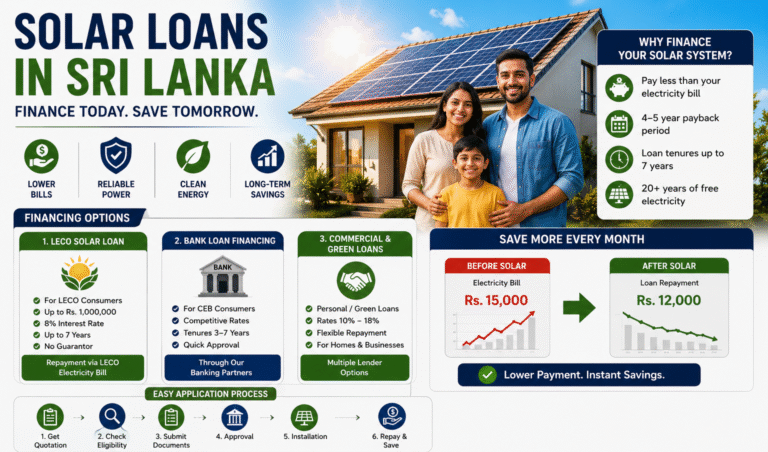
 Image Source: Web. Copyright claims: claims@theusefulindex.com — We will remove it in 24 hours.
Is Installing Solar Worth It in Sri Lanka in 2026?
The question of whether solar energy is a sound investment has shifted from theoretical to urgent for Sri Lankan households and businesses. In 2026, the landscape governing solar installation Sri Lanka has evolved significantly. Recent adjustments to Public Utilities Commission of Sri Lanka (PUCSL) tariffs, combined with fluctuating currency exchange rates, demand a rigorous financial evaluation before committing capital.
This analysis evaluates the practical sense of rooftop solar based on current 2026 pricing, regulatory frameworks, and return-on-investment (ROI) timelines. We move beyond generalities to provide specific data on solar panel cost Sri Lanka, maintenance requirements, and grid-export arrangements.
The Financial Landscape: Tariffs and Installation Costs
To determine if is solar worth it in Sri Lanka, one must first compare the cost of generation against the cost of consumption. In 2026, Sri Lankan households face a tiered electricity tariff structure that penalizes high consumption. Solar systems offer a hedge against this volatility.
Current Installation Costs (2026)
Based on prevailing market data, the all-in cost for a grid-connected system ranges between LKR 200,000 and LKR 300,000 per kWp. At an exchange rate of approximately LKR 310/USD, this translates to roughly $650 to $1,000 USD per kilowatt-peak.
| System Component | Estimated Cost (LKR) | Notes |
|---|---|---|
| Panels (Tier 1) | LKR 90,000 - 120,000 / kWp | Monocrystalline preferred for efficiency. |
| Inverter | LKR 40,000 - 60,000 / kWp | Hybrid inverters recommended for battery backup. |
| Mounting & Racking | LKR 30,000 - 50,000 / kWp | Includes labor and structural assessment. |
| Balance of System | LKR 20,000 - 40,000 / kWp | Cabling, breakers, metering equipment. |
Electricity Tariff Context
The average residential tariff in Sri Lanka has increased to offset fuel costs and grid losses. For a typical household consuming between 500 and 1,000 kWh per month, a solar installation can offset 60% to 80% of the bill immediately upon commissioning.
System Types and Selection Criteria
Choosing the right architecture depends on whether you require backup power or are strictly seeking savings from grid electricity.
1. On-Grid Systems
- Best For: Reducing monthly bills without needing battery storage.
- Mechanism: Excess energy is fed back into the grid via net metering.
- 2026 Policy Note: Recent PUCSL updates have tightened regulations on Net Plus connections for non-residential consumers, though residential net metering remains viable.
2. Hybrid Systems
- Best For: Households requiring backup power during blackouts.
- Mechanism: Integrates a battery bank with the inverter to store excess solar energy for night-time or grid failure use.
- Cost Impact: Increases upfront capital by 40% to 60% compared to on-grid systems but offers higher reliability.
3. Off-Grid Systems
- Best For: Remote properties not connected to the main utility.
- Mechanism: Fully independent of the grid with large battery banks.
- Viability: Generally less cost-effective for urban Sri Lankan homes where grid access exists, due to high battery replacement costs.
Export-Payment Arrangements and PUCSL Tariffs
A critical component of the financial equation is how the utility compensates you for surplus energy. In 2026, the Sri Lanka Solar Tariff structure has been recalibrated.
- Feed-in Tariff: The rate paid by the CEB (Ceylon Electricity Board) for exported power is typically lower than the retail tariff charged to consumers.
- Net Metering Credits: Most 2026 agreements allow households to offset their consumption directly with generated power rather than receiving cash credits for surplus. This maximizes savings but eliminates income from exports.
- New Rooftop Connections: Applications for new connections are subject to stricter technical standards regarding structural integrity and fire safety, which may impact the initial installation timeline.
Payback Calculations and ROI Analysis
The primary metric for solar panel cost Sri Lanka is the payback period. This is the time required for savings to equal the initial investment.
The Calculation Model
- Initial Investment: LKR 500,000 (approx. 4 kW system).
- Annual Savings: LKR 600,000 (based on current tariff rates and generation yield of 4-5 hours/day average).
- Simple Payback: ~8 to 10 months for pure savings, excluding maintenance.
However, this assumes stable tariffs. If the CEB raises tariffs by 10% annually, the payback period shortens significantly. Conversely, if export rates drop below LKR 25/kWh, the ROI relies entirely on self-consumption savings.
The 2026 Reality Check
Given that installation costs are in LKR and income is often pegged to local consumption, currency depreciation affects the USD value of your investment but not the local cash flow. At current exchange rates (~LKR 310/USD), a system costing $800/kWp remains competitive against regional averages.
Operational Costs and Maintenance
Long-term viability depends on upkeep. Solar panels in Sri Lanka face specific environmental challenges, including salt spray (coastal areas) and heavy monsoon rains.
- Panel Cleaning: Quarterly cleaning is recommended to prevent dust accumulation from reducing efficiency by up to 15%.
- Inverter Replacement: Hybrid inverters typically last 10 years; panels have a 25-year lifespan. Budget for inverter replacement at year 8.
- Battery Maintenance: Lead-acid batteries require water top-ups every 6 months. Lithium-ion (LiFePO4) requires minimal maintenance but is more expensive upfront.
Risks and Policy Volatility
Investing in renewable energy carries specific risks that must be weighed against the benefits.
- Regulatory Risk: Changes to PUCSL tariffs or net metering policies can occur without immediate notice. Recent policy changes have left some investors concerned about future export rates.
- Grid Dependency: If you do