

 Image Source: Web. Copyright claims: claims@theusefulindex.com — We will remove it in 24 hours.
Revenue vs Profit vs Cash Flow: The Critical Distinction Every Business Owner Needs
Many entrepreneurs operate under the dangerous assumption that a profitable business is always solvent. This misconception is the primary driver of insolvency among small businesses. To understand business finances explained, you must distinguish between three distinct metrics: revenue, profit, and cash flow. While they are interconnected, each tells a different story about your company’s health.
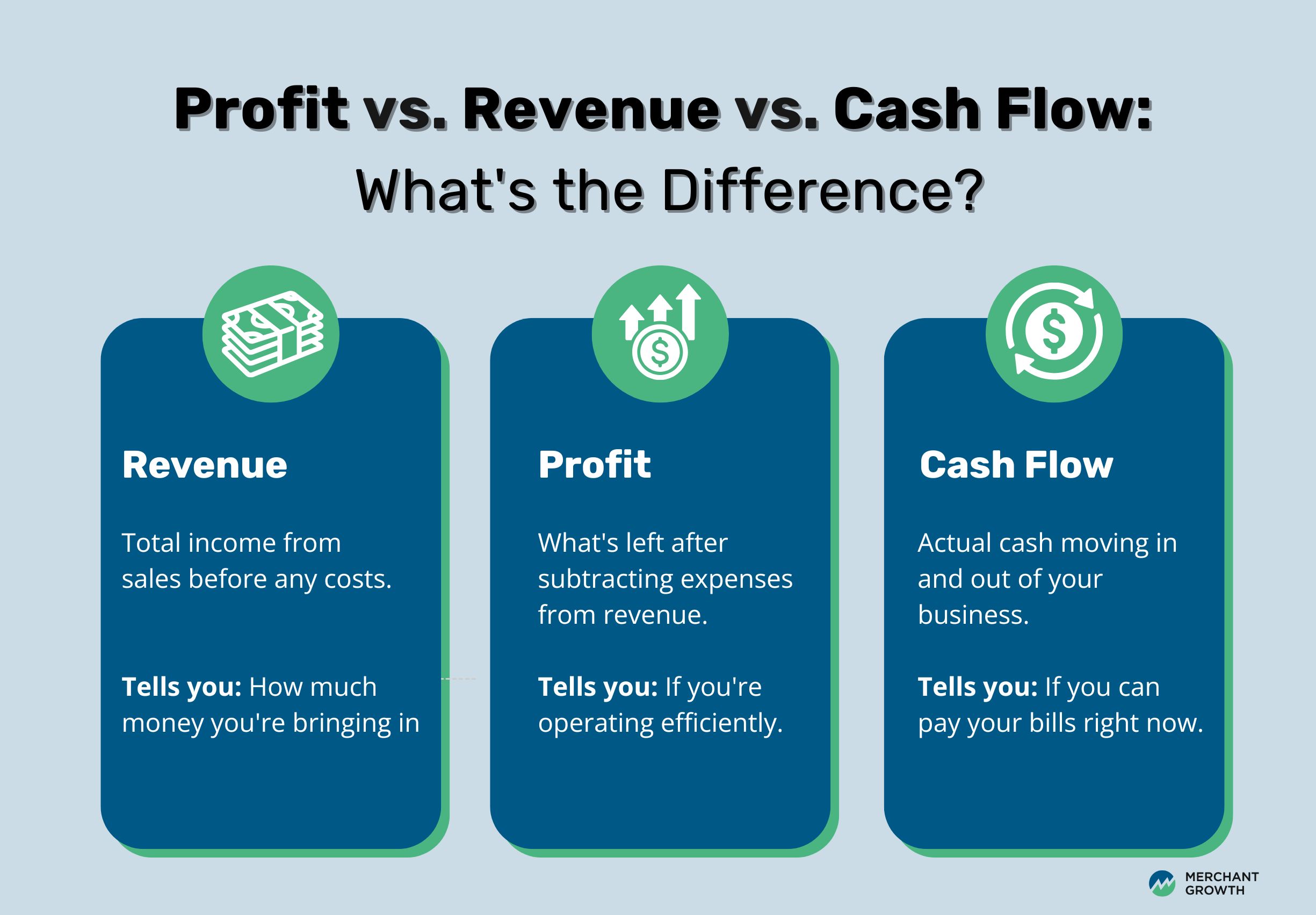
Revenue indicates what you have sold. Profit indicates how much money remains after expenses. Cash flow indicates the actual liquidity available to pay bills today. Confusing these terms leads to strategic errors that can bankrupt a healthy-looking company. This guide clarifies revenue vs profit vs cash flow, helping you manage your financial reality rather than just your accounting records.
Understanding the Three Pillars of Financial Health
To navigate cash flow for small business effectively, you must define the metrics accurately. These concepts are often conflated in casual conversation but represent different stages of financial processing.
1. Revenue (The Top Line)
Revenue represents the total amount of money generated from the sale of goods or services before any costs are deducted. It is the “top line” figure on an income statement. In accrual accounting, revenue is recognized when a transaction occurs, regardless of when payment is received.
- Formula:
Price × Quantity Sold - Key Insight: High revenue does not guarantee solvency. If you sell goods on credit, you record the revenue immediately, but the cash has not yet entered your bank account.
2. Profit (The Bottom Line)
Profit is what remains after all expenses are subtracted from revenue. It measures operational efficiency and sustainability over time. There are two primary layers of profit:
- Gross Profit: Revenue minus the Cost of Goods Sold (COGS). This shows how efficiently you produce your product.
- Net Profit: Gross profit minus operating expenses (rent, salaries, utilities) and taxes. This is the actual earnings available to owners.
3. Cash Flow (The Lifeblood)
Cash flow measures the net amount of cash being transferred into and out of a business during a specific period. It tracks actual liquidity. Positive cash flow means you have more money coming in than going out, while negative cash flow indicates a liquidity drain.
- Formula:
Cash Inflows - Cash Outflows - Key Insight: A company can show a net profit on paper but still fail if its bank account balance drops to zero due to timing differences between invoicing and payment collection.
Why Profitable Companies Run Out of Cash
The most critical lesson in business finances explained is that profitability does not equal liquidity. A business can be profitable yet insolvent due to working capital constraints. This occurs when the timing of cash inflows and outflows is misaligned.
The Timing Difference Trap
Consider a scenario where you invoice a client for $50,000 in October. You recognize this as revenue immediately under accrual accounting. However, the client pays in December. Conversely, you must pay your suppliers for raw materials in November to fulfill that order.
If you have not yet received the October invoice payment but must pay the November supplier bill, your cash balance decreases even though your profit is increasing on paper. This creates a “profitable bankruptcy” risk.
The Inventory Trap
Inventory represents money tied up in goods that have not yet been sold. If sales slow down, inventory sits on shelves, and cash remains locked away. You may report high revenue from previous periods, but current cash flow drops as you continue to pay for production costs without immediate reimbursement.
Worked Example: The Divergence of Metrics
To visualize the difference between revenue vs profit vs cash flow, consider a service-based company called “TechFix Solutions.”
| Period | Transaction | Revenue (Accrual) | Cash Inflow | Expenses (Accrual) | Net Profit Impact | Cash Flow Impact |
|---|---|---|---|---|---|---|
| October | Invoice sent for $10,000 service | +$10,000 | $0 | $2,000 (Supplies) | +$8,000 | -$2,000 |
| November | Client pays invoice | $0 | +$10,000 | $3,000 (Rent/Staff) | -$2,000* | +$7,000 |
| Total | Cumulative | +$10,000 | +$10,000 | +$5,000 | +$6,000 | +$5,000 |
*Note: In this simplified example, the net profit calculation assumes expenses are recognized in the period they occur. If the $3,000 expense was incurred in October but paid in November, the cash flow would differ from the profit calculation.
In this example, TechFix Solutions generates positive revenue and eventually positive cash flow. However, if the client had not paid in November, the company would have a negative cash balance despite having recorded $10,000 in revenue and $8,000 in profit for the month. This illustrates why cash flow management is vital; you cannot pay payroll with paper invoices.
Managing Receivables, Payables, and Inventory
Effective financial management requires controlling the three main components of working capital that create timing differences.
Accounts Receivable (Receivables)
These are amounts owed to your business by customers. High receivables mean you have recorded revenue but lack the cash to pay bills.
- Strategy: Enforce strict payment terms (e.g., Net 15). Offer early payment discounts (2/10 Net 30) to accelerate inflows.
Accounts Payable (Payables)
These are debts your business owes to suppliers. Delaying these payments preserves cash but risks damaging vendor relationships or incurring late fees.
- Strategy: Negotiate favorable terms with vendors. Pay only when due, not early, unless a bulk discount is significant enough to outweigh the cost of capital.
Inventory Management
Inventory converts into revenue only when sold. Overstocking ties up cash; understocking risks lost sales.
- Strategy: Implement just-in-time (JIT) inventory systems where possible to minimize holding costs and free up working capital.
Key Takeaways & Decision Framework
When reviewing your statements, do not rely on a single metric. Use this framework to evaluate your financial health:
- Check Revenue for Growth: Is top-line growth sustainable? High revenue with low gross margins often indicates pricing issues or rising COGS.
- Analyze Profit for Efficiency: Is net profit increasing relative to revenue? If not, your overhead costs are eating into earnings.
- Monitor Cash Flow for Survival: Ensure operating cash flow is positive month-over-month. A negative cash flow run of three consecutive months usually signals a need for immediate capital injection or expense reduction.
Revenue vs Profit vs Cash Flow: What Business Owners Often Get Wrong The most common error is ignoring the “Cash Gap.” Always ask: Can I pay my bills tomorrow? If your answer relies on next month’s invoice payment, you are in danger. Understanding these distinctions ensures long-term viability and prevents the common pitfall of profitable insolvency.
By mastering cash flow for small business owners, you move from reactive accounting to proactive financial management.