

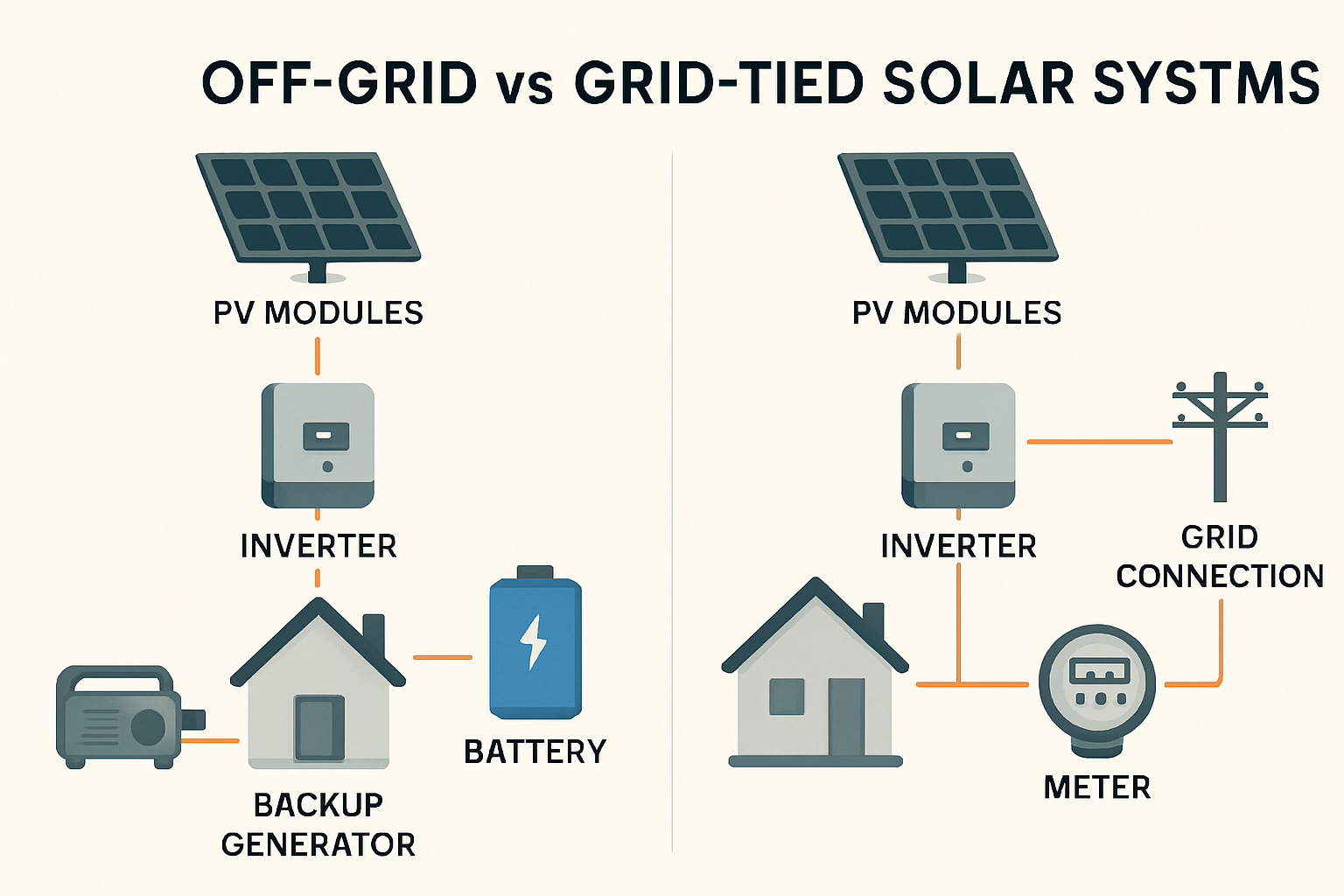
 Image Source: Web. Copyright claims: claims@theusefulindex.com — We will remove it in 24 hours.
The Core Decision: Grid Reliance or Energy Independence?
When evaluating a solar installation, homeowners face a fundamental architectural choice: rely on the utility grid for backup power or invest in energy storage to achieve autonomy. This distinction defines the difference between a standard grid-tied system, a hybrid solar system, and an off-grid configuration.
The debate often centers on two primary keywords: solar battery vs grid tied and solar with battery storage. While all three configurations generate renewable electricity, their performance during outages, upfront costs, and long-term lifecycle expenses differ significantly.
This analysis examines the technical specifications, financial implications, and operational realities of each setup to guide your decision-making process. We focus on critical factors including battery capacity, usable energy percentages, inverter compatibility, and backup loads.
Understanding the Three Solar Architectures
To make an informed choice, you must first understand the functional differences between the three primary system types available in 2026.
Grid-Tied Solar Systems
A standard grid-tied system connects directly to the utility network without a battery bank.
- Grid Access: Continuous.
- Backup Power: None during outages (unless equipped with specific safety breakers).
- Cost Profile: Lowest upfront cost per watt.
- Best For: Users who prioritize low initial investment and have reliable grid infrastructure.
Hybrid Solar Systems
A hybrid system integrates solar panels, a battery bank, and an inverter that manages both grid connection and storage.
- Grid Access: Available for normal operation and emergency backup.
- Backup Power: Yes, during utility outages (configurable).
- Cost Profile: Moderate upfront cost; higher than grid-tied, lower than off-grid.
- Best For: Homeowners seeking resilience without total energy independence.
Off-Grid Solar Systems
An off-grid system operates independently of the utility company entirely.
- Grid Access: None (relies on backup generators or large battery banks).
- Backup Power: Yes, but dependent on stored energy or generator capacity.
- Cost Profile: Highest upfront cost; requires significant oversizing for batteries and panels.
- Best For: Remote locations or those requiring 100% energy independence.
Technical Specifications: Inverters and Battery Capacity
The heart of the decision lies in the hardware selection, specifically the inverter and the battery chemistry.
Inverter Compatibility
Inverter choice dictates system flexibility. Standard grid-tied inverters (string inverters) cannot store energy. To add a solar battery, you require a hybrid inverter or a power wall unit (like the Tesla Powerwall or Enphase IQ Battery).
- Hybrid Inverters: Allow for future expansion. Industry data suggests installing a “battery-ready” hybrid inverter adds approximately $500 to the upfront cost but enables battery addition later without replacing the entire system.
- AC vs. DC Coupling: Hybrid systems utilize AC or DC coupling. DC coupling is generally more efficient and space-saving, while AC coupling allows for retrofitting batteries into existing grid-tied systems.
Battery Capacity and Usable Energy
When comparing solar battery vs grid tied setups, capacity is measured in kilowatt-hours (kWh). However, not all stored energy is accessible immediately.
- Depth of Discharge (DoD): Most Lithium Iron Phosphate (LFP) batteries allow for 90-100% DoD. Lead-acid batteries typically require 50% DoD to preserve lifespan.
- Usable Energy: A 13.5 kWh battery might only deliver 10-12 kWh of usable power depending on the inverter efficiency and safety protocols.
- Cycle Life: Modern LFP batteries often exceed 6,000 cycles (roughly 10+ years of daily cycling).
Backup Loads
A critical metric for hybrid systems is how much load you can sustain during an outage. You must calculate your essential backup loads (fridge, lighting, medical equipment) against the usable energy available in your battery bank. A system sized for whole-home backup requires significantly more capacity than a setup designed for “critical loads” only.
Cost Analysis: Lifecycle and Upfront Investment
The financial comparison between a standard grid-tied array and a hybrid solar system involves comparing Capital Expenditure (CAPEX) against Operational Expenditure (OPEX).
Upfront Costs
- Grid-Tied Only: Lowest CAPEX. You pay only for panels, racking, and the inverter.
- Hybrid System: Higher CAPEX due to battery inclusion and hybrid inverter requirements.
- Off-Grid: Highest CAPEX due to generator costs (if applicable) and massive oversizing of solar arrays to charge batteries during daylight hours.
Lifecycle Costs (LCOE)
Lifecycle cost analysis looks at the Level