

 Image Source: Web. Copyright claims: claims@theusefulindex.com — We will remove it in 24 hours.
What Is AI Integration? A Practical Guide for Small Businesses
For small business owners, the question is no longer if to adopt artificial intelligence, but how to integrate AI into a business without disrupting existing operations. AI integration services have evolved from niche tools to essential infrastructure. However, simply purchasing an algorithm does not constitute successful adoption. True value emerges when intelligent systems connect seamlessly to legacy software, data repositories, and daily workflows.
This guide explains the mechanics of connecting AI capabilities to your current stack, outlines the implementation stages required for stability, and details how to measure return on investment (ROI). Whether you are looking for AI integration for business scalability or seeking to optimize specific departments, understanding the architecture behind these tools is critical for sustainable growth.
Defining AI Integration in a Business Context
At its core, AI integration means incorporating intelligent systems that can learn, adapt, and make decisions into your existing business processes. It is distinct from standalone automation because it leverages context. For example, a generic chatbot handles FAQs, but an integrated AI agent accesses your CRM to pull specific customer history before responding.
Successful how to integrate AI into a business strategies require bridging the gap between raw data and actionable insights. This involves API connectivity, middleware platforms, and workflow orchestration. The goal is not to replace human judgment but to augment it with predictive analytics and generative capabilities.
Common Use Cases for Small Business Integration
Small businesses often lack the resources of enterprise giants. Therefore, AI integration services must focus on high-impact use cases that solve immediate pain points. Below are the primary areas where organizations typically deploy these technologies.
| Department | Typical Use Case | Benefit to Workflow |
|---|---|---|
| Customer Service | Intelligent ticket routing and sentiment analysis. | Reduces response time by 40-60%; prioritizes urgent issues automatically. |
| Sales & Marketing | Lead scoring and personalized email drafting. | Increases conversion rates; frees sales reps for closing calls. |
| Operations | Inventory forecasting and supply chain anomaly detection. | Minimizes stockouts; optimizes purchasing orders based on trends. |
| HR & Admin | Resume screening and payroll reconciliation automation. | Reduces administrative overhead by 30-50%. |
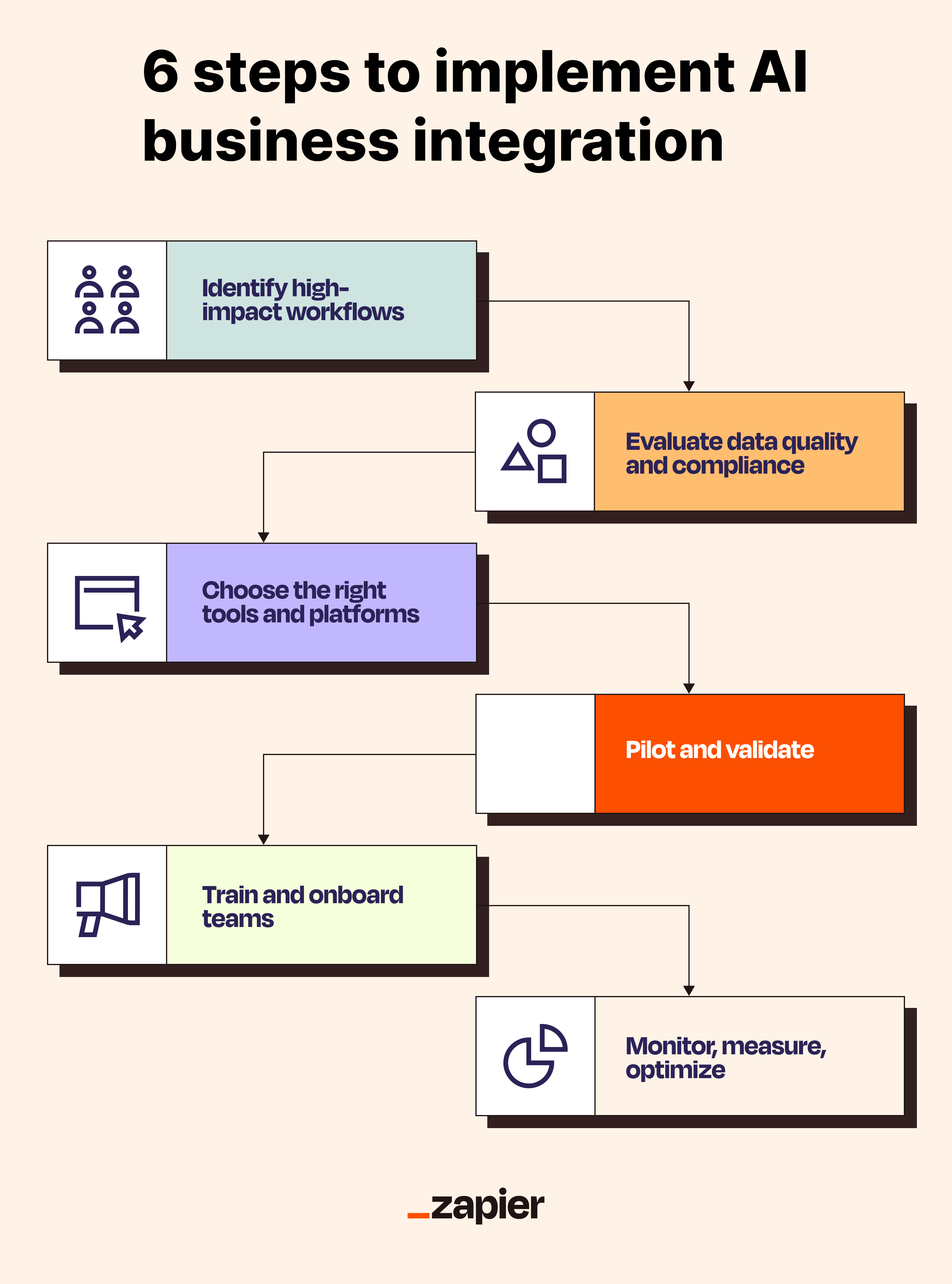
Implementation Stages: How to Integrate AI into a Business
Implementing these systems requires a structured approach. Rushing deployment without proper preparation leads to data leakage and workflow friction. Follow this roadmap for AI integration for business success.
Phase 1: Audit and Data Readiness
Before connecting any model, you must assess your current state. Most AI models require clean, structured data to function accurately.
- Inventory Check: Identify where data resides (SQL databases, spreadsheets, cloud storage).
- Quality Assessment: Ensure data is normalized and free of duplicates. Poor data quality results in hallucinations or incorrect predictions.
- Privacy Mapping: Determine which data points are sensitive (PII) and require encryption or masking before entering public models.
Phase 2: Selecting the Architecture
You must decide between building custom models or using pre-trained APIs. For most small businesses, leveraging AI integration services via API is more cost-effective.
- No-Code Platforms: Tools like Zapier or Make allow you to connect AI apps without writing code.
- Enterprise Middleware: Solutions that sit between your legacy ERP and modern AI agents.
- Cloud Providers: Utilizing AWS, Azure, or Google Cloud’s managed AI services.
Phase 3: Pilot Testing
Never deploy to all users immediately. Run a controlled pilot with a specific team or department.
- Define Success Metrics: Is the goal faster processing? Higher accuracy?
- Human-in-the-Loop: Keep a human supervisor reviewing outputs during the pilot phase to catch errors early.
Phase 4: Scaling and Governance
Once the pilot proves viable, expand the integration. Establish governance protocols for ongoing monitoring. This includes setting up alerts for model drift (when performance degrades over time) and maintaining version control for your AI tools.
Data Privacy, Security, and Compliance
Security is not an afterthought; it is a prerequisite for AI integration into a business. When connecting external models to internal data, you inherit the security posture of that provider.
- Data Sovereignty: Ensure your chosen vendor complies with regional regulations (e.g., GDPR, CCPA).
- Prompt Injection Risks: Prevent malicious actors from manipulating AI outputs through structured input validation.
- Encryption: Mandate end-to-end encryption for data in transit and at rest during the integration process.
Failure to address these security layers can result in severe compliance penalties and reputational damage. Always review the service level agreement (SLA) regarding data retention policies before signing with an AI integration services provider.
Cost Breakdown and Ongoing Expenses
Understanding the financial commitment is vital for budgeting. Costs for AI integration for business typically fall into three categories:
- Implementation Fees: One-time costs for setup, API key configuration, and data migration.
- Subscription Licensing: Monthly or annual fees based on usage volume (e.g., number of API calls or active seats).
- Infrastructure Costs: If you host models internally, factor in GPU compute resources and storage.
For small businesses, a pay-as-you-go model is often preferable to large upfront licensing fees. However, be wary of hidden costs associated with data egress or premium support tiers.
Measuring Return on Investment (ROI)
How do you justify the expense? You must track specific metrics that correlate directly to revenue or efficiency gains.
- Time Saved: Calculate hours saved per employee and multiply by average hourly wage.
- Error Reduction: Track the decrease in manual data entry errors.
- Revenue Uplift: Measure conversion rate changes after implementing predictive lead scoring.
A successful integration should show a positive ROI within 3 to 6 months of deployment. If costs exceed savings in the first year, re-evaluate the tool’s utility or switch to a more efficient AI integration services partner.
Decision Framework for Selecting Integration Tools
When evaluating vendors for your specific needs, use this checklist to avoid common pitfalls.
- Interoperability: Does the tool connect with our current software stack (e.g., Salesforce, HubSpot, QuickBooks)?
- Scalability: Can the system handle increased load as we grow?
- Security: Are there SOC 2 Type II certifications or equivalent security audits?
- Support: Is there dedicated technical support for implementation issues?
Key Takeaways
To ensure a successful transition, small businesses should focus on these core principles regarding AI integration services:
- Start Small: Begin with high-volume, low-risk tasks to build confidence and gather data.
- Data is King: Invest time in cleaning your datasets before connecting them to any AI model.
- Security First: Prioritize vendors that offer transparent data governance policies.
- Measure Rigorously: Define clear KPIs before launch to accurately track ROI.
By following these guidelines, you can effectively implement AI integration for business solutions that drive efficiency and competitive advantage without compromising on security or stability.