

Which Jobs Will AI Actually Replace by 2030? The Evidence-Based Forecast
The conversation surrounding artificial intelligence has shifted from speculative science fiction to urgent labor market reality. As models become more capable and integration costs drop, the question of jobs AI will replace is no longer academic; it is a matter of economic planning for millions of workers. Current projections suggest that up to 30% of US jobs could face significant automation by 2030, with global estimates reaching 300 million roles.
However, understanding the scope of AI job displacement requires nuance. It is rarely about a single role vanishing overnight. Instead, AI tends to automate specific tasks within an occupation while reshaping the remainder. This article examines which occupations are most exposed, distinguishes between task automation and entire jobs disappearing, and outlines practical steps for navigating the future of work.
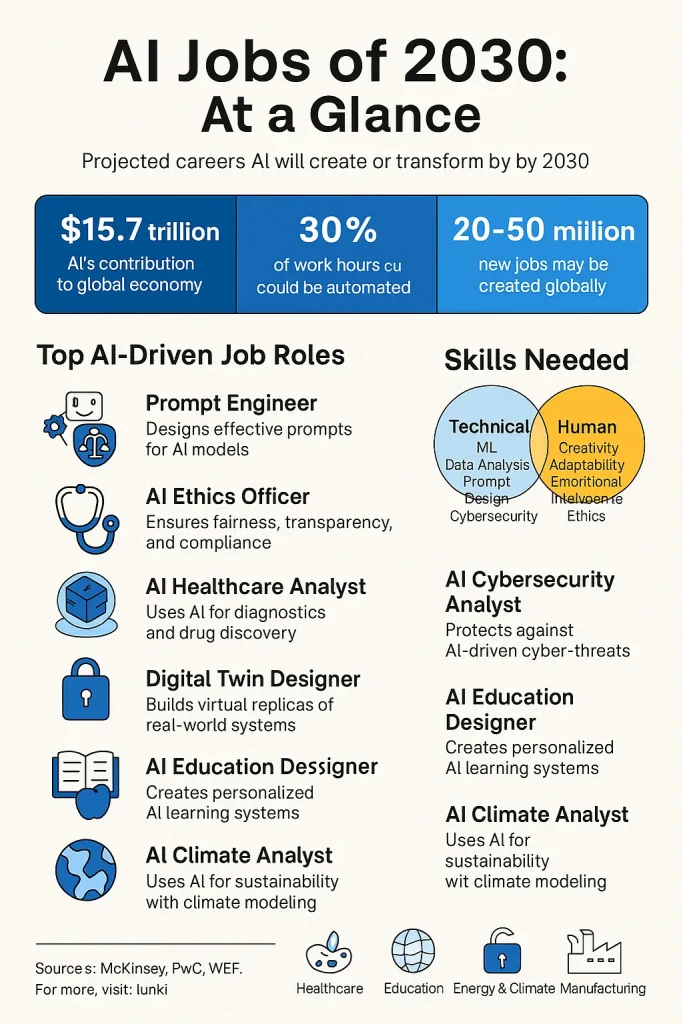 Image Source: Web. Copyright claims: claims@theusefulindex.com — We will remove it in 24 hours.
Task Automation vs. Job Disappearance
A critical distinction in analyzing jobs at risk from AI is separating task automation from total job elimination. Most roles consist of a composite of duties, some of which are susceptible to algorithmic processing while others require human judgment.
Research from the SSRN study on AI Job Displacement Analysis (2025-2030) indicates that while specific functions are highly automatable, entire occupations often persist but evolve. For example, a radiologist does not face immediate replacement by AI, but their workflow changes as diagnostic tools handle preliminary screening.
- Task Automation: Repetitive data processing, basic content generation, and routine scheduling.
- Job Disappearance: Roles where the primary value proposition is fully replicable (e.g., basic transcription, specific administrative routing).
- Augmentation: Roles where AI serves as a co-pilot, increasing productivity rather than replacing the worker entirely.
High-Risk Occupations by 2030
Based on O*NET-based risk scores and industry breakdowns from leading analysts like McKinsey and Goldman Sachs, specific sectors face higher exposure to automation. The following categories represent occupations where jobs AI will replace are most concentrated.
Administrative and Data Processing
Roles focused on structured data entry and routine communication are the primary targets for early-stage LLM (Large Language Model) integration.
- Data Entry Clerks: High risk due to digitization and OCR technologies.
- Bookkeeping and Accounting Assistants: Routine transaction processing is increasingly handled by AI tools.
- Customer Service Representatives: Tier-1 support queries are being resolved by chatbots, reducing the need for human agents in standard scenarios.
Transportation and Logistics
While autonomous vehicles (AVs) face regulatory hurdles, the backend logistics of dispatching and route optimization are already automated.
- Dispatchers: Route planning algorithms now outperform human planners in efficiency.
- Warehouse Picking: Collaborative robots (cobots) handle repetitive lifting and sorting tasks.
Healthcare Support Roles
Diagnostic imaging and patient monitoring are seeing rapid AI adoption.
- Medical Scribes: AI documentation tools transcribe doctor-patient conversations, reducing administrative burden.
- Radiology Technicians: While the physical act remains human, interpretation support is highly automated.
Risk Assessment Table: Occupations Most Exposed to Automation (2026-2030)
| Occupation | Primary Risk Factor | Estimated Displacement Timeline | Mitigation Potential |
|---|---|---|---|
| Telemarketers | Voice AI & Scripting | Immediate - 2 Years | High (Requires Human Pivot) |
| Legal Assistants | Document Review | 3-5 Years | Medium (Focus on Strategy) |
| Translator / Interpreter | NLP Translation | 4-6 Years | Low (Contextual Nuance) |
| Radiology Technicians | Diagnostic Support | 5+ Years | High (Human Oversight) |
| Travel Agents | Booking Engines | Immediate - 1 Year | Medium (Consultative Role) |
Note: Risk scores are derived from aggregated data including ONET task similarity and AI capability benchmarks.*
Industries with Lower Exposure to Displacement
Not all sectors face the same threat. Roles that require complex physical dexterity, high-stakes emotional intelligence, or strategic oversight remain more resilient.
- Skilled Trades: Plumbers, electricians, and HVAC technicians operate in unstructured environments where AI robotics cannot yet navigate effectively.
- Healthcare Providers: Nurses and doctors require empathy and complex decision-making under uncertainty that current AI cannot replicate.
- Creative Strategy: While AI can generate images or text, the strategic direction of marketing campaigns, brand storytelling, and high-level creative direction remains human-centric.
Limitations of Current Forecasts
While the data is compelling, it is important to avoid determinism. Forecasts regarding jobs at risk from AI often suffer from three specific limitations:
- Adoption Curves: Technology penetration is slower than predicted. Regulatory frameworks in healthcare and transportation are delaying full automation implementation.
- Economic Constraints: High costs of integration mean small businesses may not adopt AI tools immediately, preserving human labor for longer.
- Unforeseen Use Cases: History shows that new technologies often create demand for adjacent roles. The creation of “AI Trainer” or “Prompt Engineer” roles did not exist in 2020 but are now standard.
Practical Steps for Workers Facing Displacement
If you are concerned about your position in the future of work, passive observation is insufficient. Active adaptation is required to secure long-term employability.
1. Develop AI Literacy
Understanding how generative models function allows you to leverage them rather than fear them. Learn to prompt effectively, verify outputs for hallucinations, and understand data privacy implications.
2. Double Down on Soft Skills
Empathy, negotiation, leadership, and complex problem-solving are difficult to automate. These skills become more valuable as machines handle routine tasks.
3. Pivot Within Your Industry
If your specific task is being automated, look for adjacent roles within the same sector. A customer service manager can move into retention strategy; a data entry clerk can move into data analysis.
4. Build a Portfolio of Augmentation
Demonstrate how you use AI to increase output quality and speed. Employers value workers who can integrate new tools into existing workflows, not just those who resist change.
Key Takeaways: Decision Framework for the Future of Work
To navigate the transition toward 2030, apply this framework when evaluating your career path:
- Assess Task Composition: Break your daily job down. If more than 50% of your time is spent on repetitive, structured tasks, you are at higher risk of automation.
- Evaluate Human Interaction: Roles requiring deep human connection or high-stakes accountability are less likely to be fully replaced by AI systems in the short term.