

 Image Source: Web. Copyright claims: claims@theusefulindex.com — We will remove it in 24 hours.
Why Do Lithium Batteries Lose Capacity Over Time? The Science of Degradation
Lithium-ion batteries are the backbone of modern portable electronics and electric mobility, yet they are not immortal. A fundamental question for consumers and engineers alike is why lithium battery degradation occurs. Understanding why batteries lose capacity is essential for managing expectations regarding device longevity and total cost of ownership. While capacity fade is inevitable, it is governed by specific chemical mechanisms and operational stressors.
This editorial examines the chemistry behind ageing, environmental factors, and usage patterns that drive these changes. By analyzing battery lifespan explained, we provide a technical overview of how to mitigate wear in energy storage systems.
The Two Faces of Battery Ageing: Calendar vs. Cycle Life
To understand lithium battery degradation, one must distinguish between two primary modes of ageing. These mechanisms operate simultaneously but are driven by different factors.
1. Calendar Ageing
Calendar ageing refers to the loss of capacity that occurs simply due to the passage of time, regardless of usage. Even when a battery is stored in a charged state at room temperature, internal chemical reactions continue to degrade the cell. This self-discharge process reduces the available energy over years rather than hours. Research indicates that most EV batteries have a lifespan of seven to 10 years before they need replacement primarily due to these intrinsic time-based factors.
2. Cycle Life Degradation
Cycle life degradation occurs during active use. Every time a battery is charged and discharged, physical and chemical changes occur within the electrode materials. While modern cells can withstand thousands of cycles, each cycle contributes to cumulative wear.
The Chemistry Behind Capacity Loss
The internal structure of a lithium-ion cell is complex. Capacity loss is not merely about running out of fuel; it involves structural damage to the components themselves.
Solid Electrolyte Interphase (SEI) Growth
The first layer of degradation is the growth of the Solid Electrolyte Interphase (SEI). This protective film forms on the anode during the initial charge cycles. Over time, this layer thickens as it consumes active lithium ions and electrolyte material. As the SEI grows, fewer lithium ions remain available to carry current, directly reducing the battery’s measured capacity.
Lithium Plating
At high charging voltages or low temperatures, lithium ions may deposit on the anode surface rather than intercalating into the graphite structure. This process is known as lithium plating. It creates dendritic structures that can lead to internal short circuits and permanently removes active lithium from the cycle.
Electrode Degradation
The positive and negative electrodes undergo mechanical stress during expansion and contraction. Over thousands of cycles, this leads to particle cracking and loss of electrical contact between active material particles and the current collector. This structural disconnection renders portions of the electrode inactive.
Environmental Stressors: Temperature and Self-Discharge
Temperature is arguably the most significant external variable affecting battery lifespan explained.
Thermal Degradation
Heat accelerates almost all chemical reactions within the cell, including the growth of the SEI layer and electrolyte decomposition. Conversely, extreme cold slows down ion mobility, increasing internal resistance. While a battery may function in the cold, repeated exposure to high temperatures (>45°C / 113°F) significantly accelerates capacity fade.
Self-Discharge
Batteries have even higher rates of self-discharge, which is when the battery’s internal chemical reactions reduce stored energy and degrade its capacity over time. This is a primary driver of calendar ageing.
Usage Patterns That Accelerate Wear
How you use your device impacts how quickly it ages. Several specific habits can drastically alter the degradation rate.
Depth of Discharge (DoD)
Shallow discharges are generally healthier for battery health than deep discharges. Regularly draining a battery to 0% or charging it to 100% repeatedly places higher stress on the electrodes compared to maintaining a state-of-charge (SoC) between 20% and 80%.
Charge Cycles
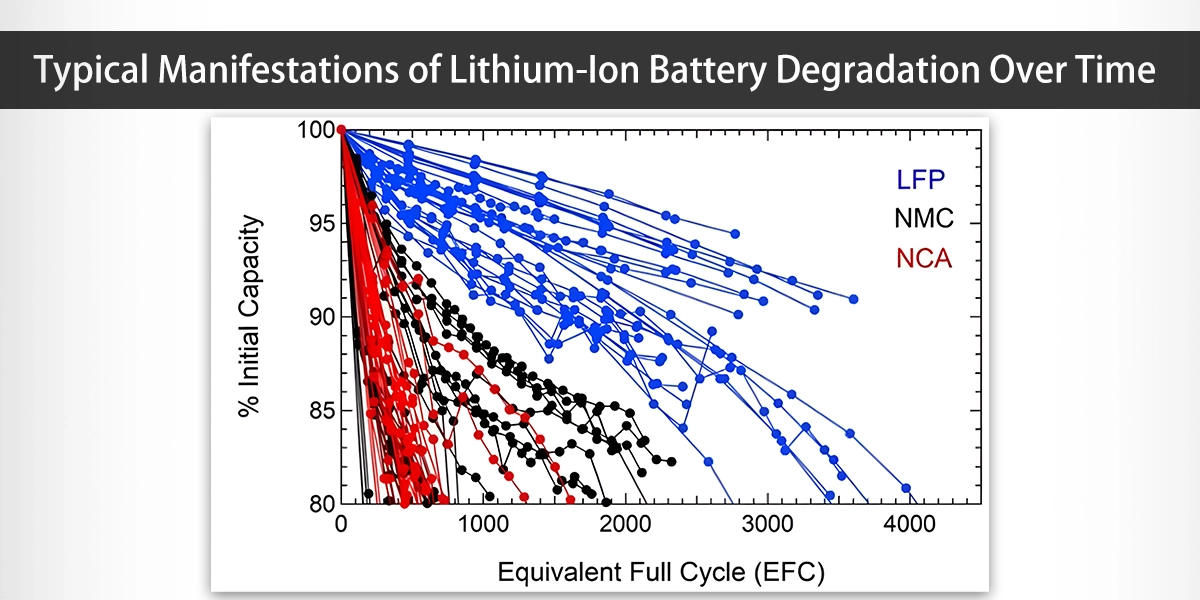
A charge cycle is defined as using 100% of the battery’s capacity, whether in one go or over multiple days. For example, draining from 100% to 50% and then 50% to 0% counts as one cycle. Manufacturers typically rate batteries for a specific number of full cycles (e.g., 1,000 or 2,000) before capacity drops below 80%.
Charging Habits
Charging habits play a critical role in lithium battery degradation. Keeping a battery at 100% state-of-charge for extended periods while connected to a charger (common with laptops) maintains high voltage stress on the cathode. Similarly, leaving a device plugged in overnight can contribute to SEI growth.
Factors Influencing Degradation Rate
The following table summarizes how different variables interact to impact capacity loss over time.
| Factor | Impact on Capacity Loss | Mitigation Strategy |
|---|---|---|
| High Temperature | Accelerates chemical reactions and electrolyte breakdown. | Keep devices in cool environments; avoid direct sunlight. |
| Deep Discharge (DoD) | Increases mechanical stress on |